
Platted on the Wabash in 1825
Epoxy Flooring in Lafayette, IN
Coatings for Lafayette's century-old garages, busy rental basements and working shop floors, starting with real repair work on the slab.
- Free on-site estimate with a slab moisture test
- Itemized written quote before any grinding starts
- Every floor diamond ground and patched before coating
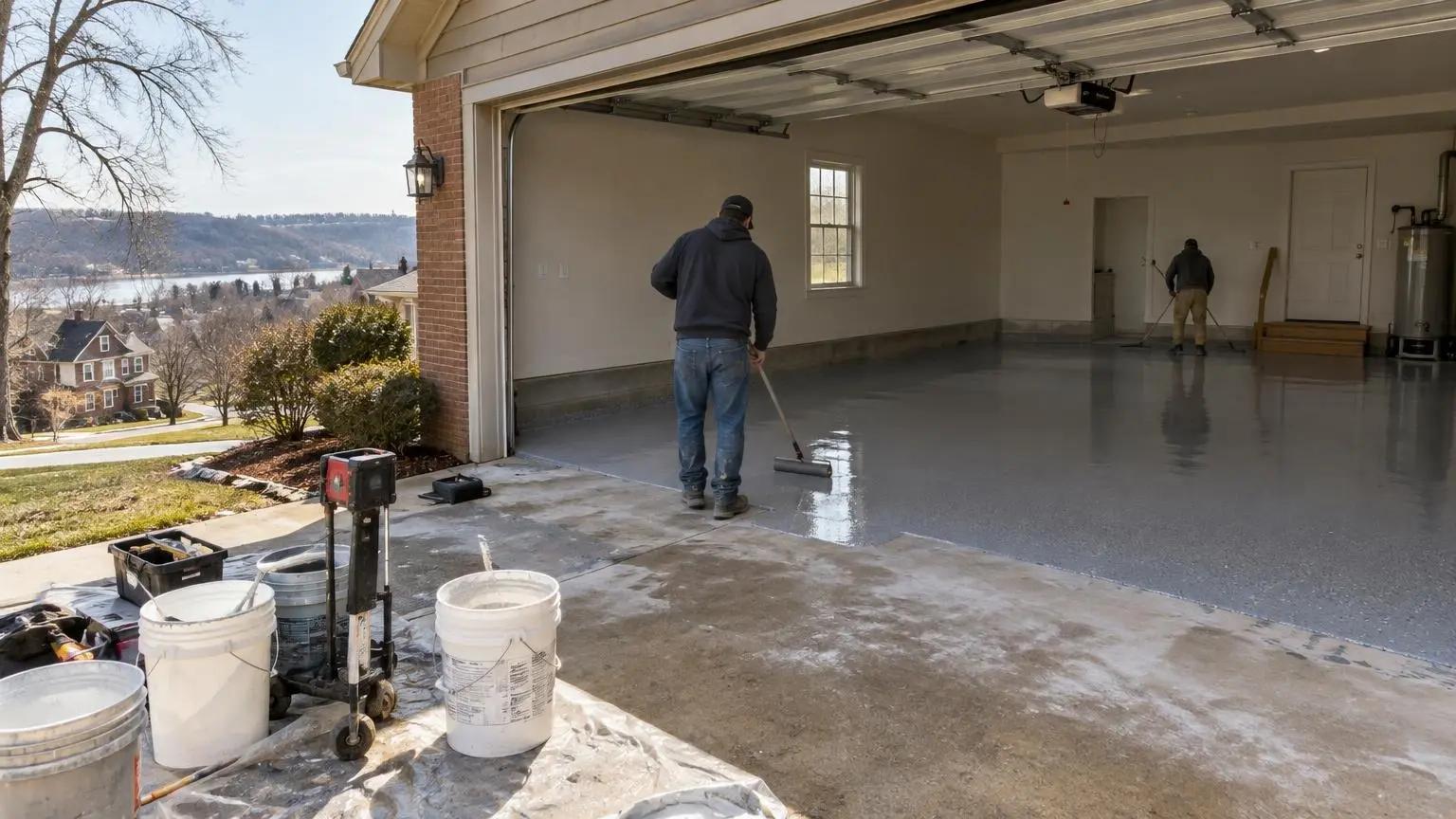
Lafayette Floors Have a Long History
Epoxy flooring in Lafayette often starts with a slab that has outlived several owners. William Digby platted the town in May 1825 on the southeast bank of the Wabash, and it became the Tippecanoe County seat the next year. A city that old has garages poured in almost every decade since cars arrived. Some floors are thin and hand-finished. Some have been painted three times. Some were poured last year. We coat all of them, and the prep is different for each.
Garages in the historic neighborhoods
The Ninth Street Hill Neighborhood Historic District alone covers about 30 acres and 88 contributing buildings, put up between roughly 1850 and 1946. Its houses run from Greek Revival and Gothic Revival to Italianate, Second Empire and Queen Anne. Districts like Perrin, Highland Park, Jefferson, Ellsworth and St. Mary hold similar stock. Most of these homes were built before the car, so the garage came later. It is usually detached, set at the back of the lot, and sitting on a slab that was poured with whatever was standard at the time.
On those floors we tend to find:
- Old porch or floor paint that has to be ground off completely
- Settlement cracks that have opened and closed for decades
- Low spots where water pools after you pull in
- Rough patches where someone filled a hole with mortar
- A slab that is thinner at the edges than in the middle
A coating cannot hide a moving slab. It can make a sound but tired one look and clean like new. We fill cracks with a rigid or flexible repair material based on how the crack behaves, grind patches flush, and then build the coating over a flat, continuous surface.
A city of renters and landlords
Point2Homes' summary of Census data shows that of 32,242 occupied housing units in Lafayette, 46.7% are owner-occupied and 53.3% are rented. That is a lot of basements, laundry rooms and shared garages that change hands every lease. Landlords ask us for floors that clean up fast at turnover. A sealed basement floor does not soak up spills or hold odors the way bare concrete does. A coated garage in a duplex or small multifamily building wipes down between tenants instead of keeping the last renter's oil stains.
For rental properties we usually suggest:
- A solid color or tight flake blend that hides wear without looking busy
- A topcoat with added grip in laundry areas and near floor drains
- Coved edges where the floor meets the wall in utility rooms, so mop water does not sit in the seam
- Scheduling around move-out so the floor has time to cure before the next tenant
Hot, wet summers matter too
Winter salt gets the attention, but Lafayette's summers are hard on floors in their own way. July is the wettest month, averaging 5.01 inches of rain, against 1.95 inches in February. The city's record high is 106°F, set in July 1954, and its record low is -25°F. A floor here has to live through that whole range. Humid summer air condenses on cool basement slabs, and storms can push water through a garage door seal. We check moisture in every season and choose primers that suit what the slab is doing that day.
Floors where people work
Lafayette is a manufacturing town. Wabash National builds semi-trailers here, Subaru of Indiana Automotive builds cars, and Caterpillar runs its Large Engine Center in the city. Many people who work in those plants keep their own shops at home, with lifts, welders, parts washers and engine stands. A home shop floor sees more abuse than a family garage. We install thicker 100% solids systems there, with chemical-resistant topcoats that stand up to brake fluid, coolant and solvent. For small commercial spaces, such as service bays, back rooms and storage areas, we plan the work in sections so you can keep part of the space open.
Newer homes in Lafayette, too
Not every Lafayette slab is old. The same Point2Homes summary shows 9.4% of the city's homes were added from 2000 to 2009 and 7.9% from 2010 to 2019. Those newer garages on the edges of town usually have a smooth, hard-troweled finish. That smoothness is a problem for coatings, because nothing grips glassy concrete. We grind every new slab the same way we grind old ones, so the base coat bonds into the concrete instead of sitting on top of it.
How we price a Lafayette floor
We do not quote by phone, because two garages of the same size on the same street can need very different prep. At the estimate we measure the floor, take a moisture reading, and note every crack, stain and old coating. Then you get a written quote that lists the grinding, the repairs, each coat and the total. If something changes once the old paint is off, we write it up and you approve it before we do the work.
A few things move the price the most on Lafayette floors:
- How much old paint or coating has to come off
- The number and width of cracks, and whether they are still moving
- Oil that has soaked deep into the slab
- Moisture readings that call for a special primer
- The finish you choose: solid color, partial flake or full flake, with an epoxy or polyaspartic topcoat
What to Know in Lafayette
- Ninth Street Hill. This historic district covers about 30 acres with 88 contributing buildings built between about 1850 and 1946. It was listed on the National Register of Historic Places in 1997.
- More renters than owners. Of 32,242 occupied housing units, 46.7% are owner-occupied and 53.3% are renter-occupied, according to Census figures summarized by Point2Homes.
- Weather extremes. Lafayette's records run from -25°F to 106°F. July is the wettest month at 5.01 inches on average, and February the driest at 1.95 inches.
- A manufacturing base. Wabash National, Subaru of Indiana Automotive, Caterpillar's Large Engine Center and Evonik's Tippecanoe Laboratories all operate in Lafayette.
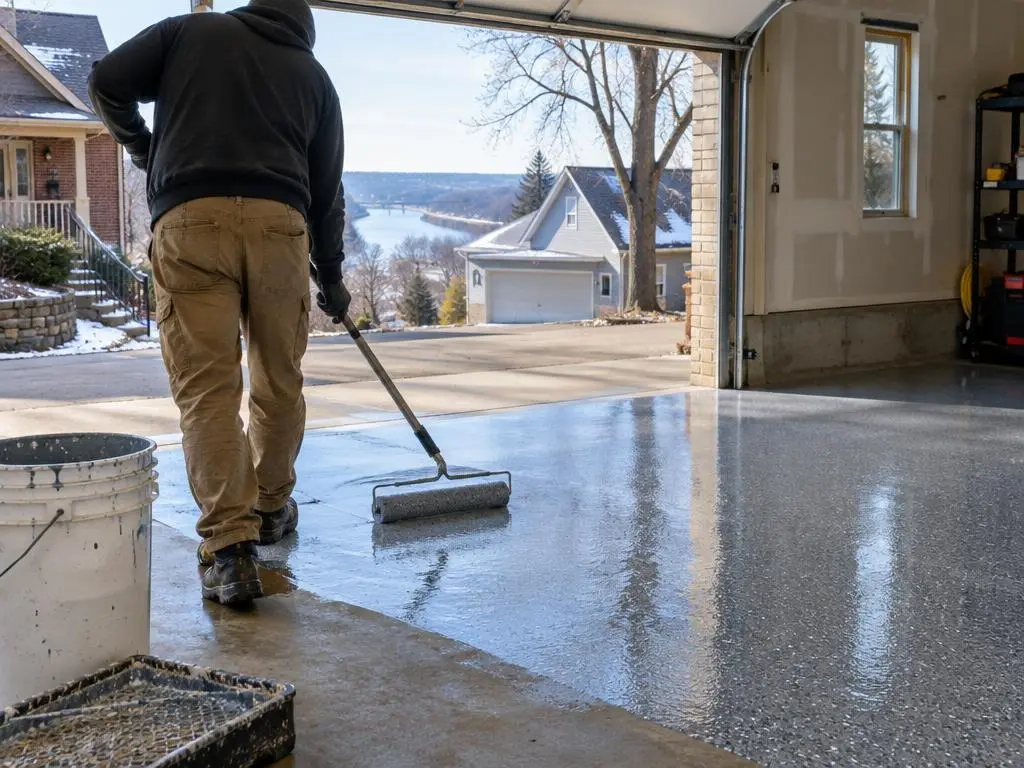
Lafayette Questions
Can you coat the floor of an old detached garage in a Lafayette historic district?
Yes, in most cases. A floor coating is interior work on the slab. We grind off old paint, repair cracks and level low spots before coating. If the slab is heaving or broken through, we will tell you it needs concrete work first. If your project also changes the outside of the garage in a historic district, check with the city before that part begins.
Do you coat floors in rental properties?
Yes. We coat basements, laundry rooms and garages in single-family rentals, duplexes and small multifamily buildings. We plan the work between tenants and give you written cure times so the next move-in does not damage a fresh floor.
My basement floor sweats in summer. Can it still be coated?
Often it can. Condensation on a cool slab and water rising through the slab are different problems. We test the floor to see which one you have. Condensation usually calls for a dehumidifier and a suitable primer. Water coming up through the concrete may need to be solved before any coating goes down.
Free Estimates in Lafayette, IN
Free on-site estimates anywhere in Lafayette, from Ninth Street Hill to the newest subdivisions.
Epoxy Flooring Near Lafayette
- Epoxy Flooring in West Lafayette, IN
- Epoxy Flooring in Battle Ground, IN
- Epoxy Flooring in Dayton, IN
- Epoxy Flooring in Shadeland, IN
- Epoxy Flooring in Clarks Hill, IN
- Epoxy Flooring in Otterbein, IN
- Epoxy Flooring in Brookston, IN
- Epoxy Flooring in Delphi, IN
- Epoxy Flooring in Flora, IN
- Epoxy Flooring in Monticello, IN
- Epoxy Flooring in Frankfort, IN
- Epoxy Flooring in Rossville, IN
- Epoxy Flooring in Mulberry, IN
- Epoxy Flooring in Crawfordsville, IN
- Epoxy Flooring in Linden, IN
- Epoxy Flooring in Attica, IN
- Epoxy Flooring in Williamsport, IN
- Epoxy Flooring in Covington, IN
- Epoxy Flooring in Fowler, IN
- Epoxy Flooring in Oxford, IN